
Publications
Nos publications, actualités et posts sur le conseil aux entreprises de crypto, la vie privée, la blockchain, la conformité et la réglementation financière.
ATOMIC SWAPTIONS: CRYPTO DERIVATIVES WITHOUT A TRUSTED THIRD PARTY
Lire la suite : ATOMIC SWAPTIONS: CRYPTO DERIVATIVES WITHOUT A TRUSTED THIRD PARTYIntroduction Derivatives let crypto users hedge price risk, but trading them on centralized venues brings back the counterparty and custody risks that crypto set out to remove. This article walks through a research paper that builds option contracts settling directly between two parties and works through how these instruments interact with the EU financial regulation.…
Unregulated Funds in Disguise: FINMA Targets AMCs in Portfolio Management
Lire la suite : Unregulated Funds in Disguise: FINMA Targets AMCs in Portfolio ManagementSummary On 3 June 2026 FINMA published Guidance 03/2026 on the risks associated with the use of products in individual portfolio management. The Guidance responds to a sharp rise in escalation cases concerning portfolio managers under Article 17 Financial Infrastructure Act (“FinIA”): 68 new supervisory cases opened in 2025, against 44 in 2024 and 9…
Listing Act: Prospectus Regulation Amendments
Lire la suite : Listing Act: Prospectus Regulation AmendmentsIntroduction Regulation (EU) 2024/2809 (part of the so-called “Listing Act”), published in the Official Journal of the EU on 14 November 2024 and in force since 4 December 2024, introduces significant amendments to Regulation (EU) 2017/1129 (the “Prospectus Regulation”). Most of its provisions will become applicable on 5 June 2026, simultaneously with the entry into…
THE NEW SWISS LAW ON SPACE OPERATIONS: SCOPE, APPLICATION AND AUTHORIZATION – PART 1
Lire la suite : THE NEW SWISS LAW ON SPACE OPERATIONS: SCOPE, APPLICATION AND AUTHORIZATION – PART 1Introduction In the previous article, we introduced and described the new draft law on space operations in Switzerland (“LOS”), which is expected to enter into force by 2028, covering both international and national space operations. In this article, we will examine and comment on the key provisions concerning the subject matter, the scope of application,…

THE NEW SWISS LAW ON SPACE OPERATIONS: AN INTRODUCTION: PART 0
Lire la suite : THE NEW SWISS LAW ON SPACE OPERATIONS: AN INTRODUCTION: PART 0Introduction This article is the first in a series dedicated to the new Swiss draft Federal Act on Space Operations. In this introductory instalment (Part 0), we provide an overview of the rationale, the comparative legal context, and the key pillars of the proposed legislation. Subsequent articles will examine each area in greater depth, including…
AI ACT IN AVIATION: EASA GUIDANCE
Lire la suite : AI ACT IN AVIATION: EASA GUIDANCEIntroduction Article 108 of the EU Artificial Intelligence Act (“AI Act”) introduces a significant amendment to one of the cornerstone instruments of European aviation law: Regulation (EU) 2018/1139 (the “Basic Regulation”). Because this Regulation forms the legal basis for the EU’s entire civil aviation framework, including the unmanned aviation regime, the modification has a direct…
THE CRYPTO-ASSET REPORTING FRAMEWORK (CARF)
Lire la suite : THE CRYPTO-ASSET REPORTING FRAMEWORK (CARF)Introduction The Common Reporting Standard (“CRS”) was designed to strengthen tax transparency by facilitating the automatic exchange of information on financial accounts. The emergence of crypto-assets, facilitating peer-to-peer value transfers without the need for traditional intermediaries, has introduced complex challenges for tax compliance and transparency frameworks. In response to these developments the OECD approved a…
Switzerland’s New Legislative Proposal on Stablecoins and Crypto Assets
Lire la suite : Switzerland’s New Legislative Proposal on Stablecoins and Crypto AssetsIntroduction On October 22, 2025, Swiss Federal Council published a new draft for legislative amendments to cover new players and services such as stablecoins and crypto-asset trading platforms. The goal is to apply the principle of “same business, same risks, same rules”, ensuring a level playing field for traditional institutions and fintech/crypto firms, while maintaining…
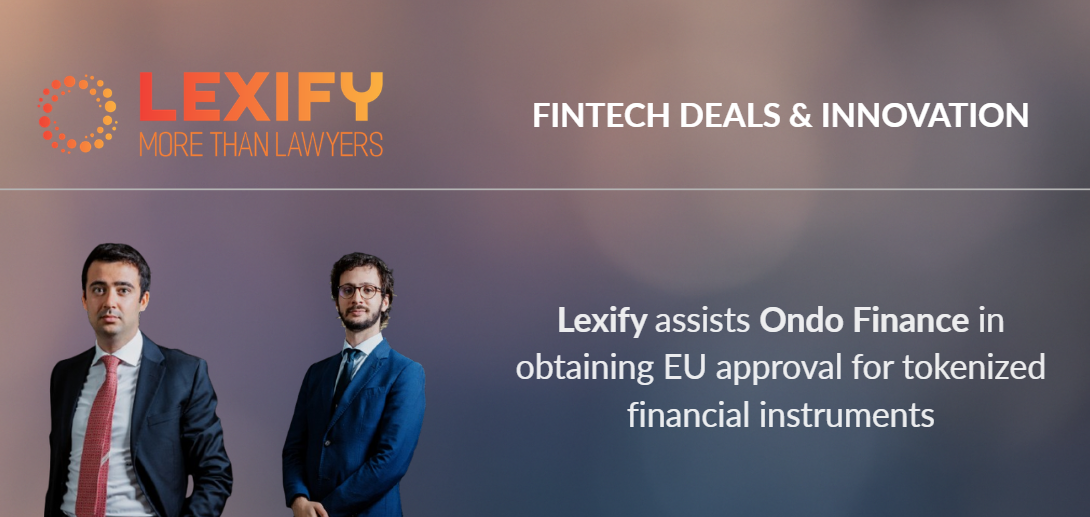
Lexify advises Ondo Finance on the European launch of Ondo Global Markets products
Lire la suite : Lexify advises Ondo Finance on the European launch of Ondo Global Markets productsLexify is pleased to announce that it has acted as legal counsel to Ondo Finance in connection with the European launch of the Ondo Global Markets products. Lexify assisted Ondo Finance in all legal and regulatory aspects relating to the approval and passporting in the European Union of the Base Prospectus for the Ondo Global…
U-SPACE SERVICE PROVISION IN EUROPE, SWITZERLAND AND DUBAI
Lire la suite : U-SPACE SERVICE PROVISION IN EUROPE, SWITZERLAND AND DUBAIIntroduction Introduction As of today, the number of certified U-space Service Providers (“USSPs”) in Europe remains very limited. Italy’s d-flight and ANRA Technologies (certified by EASA in 2023) represent two leading examples in the European Union. This scarcity of certified USSPs reflects the complexity of the regulatory framework and the demanding certification process, which requires…
ISO/IEC 42005:2025: AI IMPACT ASSESSMENT
Lire la suite : ISO/IEC 42005:2025: AI IMPACT ASSESSMENTIntroduction The increasing regulatory, ethical, and operational scrutiny on artificial intelligence (“AI”) systems necessitates structured governance mechanisms. ISO standards introduced are grounded in the plan, do, check, and act (“PDCA”) cycle, mirroring quality assurance traditions. This article explores how organisations can systematically embed AI Impact Assessments (“AI-IAs”) within this cycle, aligning with ISO 42005 Clause…
E-ID IN SWITZERLAND: WHAT CHANGES NOW
Lire la suite : E-ID IN SWITZERLAND: WHAT CHANGES NOWSummary On 28 September 2025, Swiss voters approved the federal e-ID (through swiyu Wallet app) law by a razor-thin margin (about 50.4% in favour).That result reverses the 2021 rejection and gives the Confederation the green light to offer a state-run, optional and free digital identity. Why E-ID? The new framework lets people prove who…
Incorporating a Swiss Company with Crypto
Lire la suite : Incorporating a Swiss Company with CryptoIntroduction Can you really found a Swiss company and pay in the initial capital with crypto?Yes, Swiss law allows it, provided you follow a few well-defined steps. At Lexify, we guide founders through this process end-to-end so the legal, audit, and notary pieces fit together smoothly. First, pick the right vehicle In Switzerland, most founders…
CRD VI’S NEW BRANCH REGIME: WHAT IT MEANS FOR NON-EU ASSET MANAGERS
Lire la suite : CRD VI’S NEW BRANCH REGIME: WHAT IT MEANS FOR NON-EU ASSET MANAGERSSummary Directive (EU) 2024/1619 (“CRD VI”) introduces an EU-wide, mandatory branch regime for third-country banking business (deposit-taking, lending, guarantees/commitments). In contrast, Directive 2014/65/EU (“MiFID II”) keeps branch requirements for third-country investment firms (e.g., Swiss asset managers) as an option each Member State may choose to impose and preserves the very narrow so-called “reverse solicitation”…
THE IMPORTER OF DRONES IN EUROPE? HERE’S WHAT YOU NEED TO KNOW
Lire la suite : THE IMPORTER OF DRONES IN EUROPE? HERE’S WHAT YOU NEED TO KNOWIntroduction Regulation (EU) 2019/945 (the “Regulation”) is a key legislative act within the European Union that lays down the rules for the design, manufacture, and placing on the market of unmanned aircraft systems (“UAS” or “Drones”). The Regulation has undergone multiple amendments to reflect technological evolution and market needs, ensuring safety, traceability, and harmonization…
CONCENTRATION RISK
Lire la suite : CONCENTRATION RISKIntroduction FINMA Circular 2025/2 introduces guidance on conduct obligations under the Financial Services Act (FinSA), including the management of concentrations risks (hereinafter, the “Circular”). The Circular indicates as reference thresholds: when these limits are exceeded, the portfolio manager is required to notify the client about the associated risks. These thresholds are indicative, not absolute,…
AI ACT IN DEFENCE: A TRUE EXEMPTION?
Lire la suite : AI ACT IN DEFENCE: A TRUE EXEMPTION?Introduction In recent years, the use of artificial intelligence (AI) in the field of defence has attracted increasing strategic and regulatory attention. The entry into force of the Regulation (EU) 2024/1689 (the “AI Act”), the European regulation aimed at governing the development and deployment of artificial intelligence systems, has raised significant questions for the…
GUIDELINES ON GPAI UNDER THE AI ACT
Lire la suite : GUIDELINES ON GPAI UNDER THE AI ACTIntroduction With the adoption of Regulation (EU) 2024/1689 (the “AI Act”), the European Union has introduced a horizontal framework governing the entire life‑cycle of artificial‑intelligence systems. Article 96(1) of the AI Act mandates the Commission to issue guidelines clarifying the practical application of the Regulation (the “Guidelines”). The Guidelines cover four core areas: definition…
FINANCIAL DATA ACCESS REGULATION (FIDA)
Lire la suite : FINANCIAL DATA ACCESS REGULATION (FIDA)Introduction The European Union has been developing a unified regulatory approach to create a single market for data (both personal and non-personal). Since 2020, the EU’s initiatives such as the European Data Strategy and Digital Finance Strategy have advanced efforts to regulate data collection, handling, and exchange. In line with these objectives, the EU…
AI CANNOT BE AN INVENTOR
Lire la suite : AI CANNOT BE AN INVENTORIntroduction In a landmark ruling (case B-2532/2024), the Swiss Federal Administrative Court has definitively held that artificial intelligence (“AI”) systems cannot be recognized as inventors under the Swiss legal framework. The Court’s decision marks a significant precedent in the global discourse on intellectual property (“IP”) and the legal personality—or lack thereof—of autonomous AI systems.…
FATF updates lists of high-risk jurisdictions
Lire la suite : FATF updates lists of high-risk jurisdictionsIntroduction The Financial Action Task Force (“FATF”) continuously monitors the jurisdictions and their actions to combat money laundering, terrorist and proliferation financing. The results are published three times a year. During the plenary meeting on June 13, 2025, the FATF updated its statements on: High-Risk Jurisdictions subject to a Call for Action High-risk jurisdictions…
AI Literacy under AI Act
Lire la suite : AI Literacy under AI ActIntroduction Article 4 of the Regulation (EU) 2024/1689 (“AI Act”) imposes a new Artificial Intelligence (“AI”) literacy obligation on all providers and deployers of AI systems. In essence, these organizations “shall take measures to ensure, to their best extent, a sufficient level of AI literacy” among their staff and other persons dealing with AI systems…
Blockchain e arte: le nuove regole del digitale
Lire la suite : Blockchain e arte: le nuove regole del digitaleAlla conferenza SwissLedger – Art Edition, il nostro Lars Schlichting ha sottolineato l’impatto legale delle tecnologie digitali nell’arte: la blockchain garantisce autenticità e tracciabilità delle opere. L’iniziativa, promossa a Lugano, usa AI e registri decentralizzati per proteggere e valorizzare il patrimonio artistico.
Il nostro intervento sul Corriere del Ticino: investimenti e truffe
Lire la suite : Il nostro intervento sul Corriere del Ticino: investimenti e truffeLe monete digitali offrono nuove opportunità in termini di libertà finanziaria e inclusività, presentandosi come un’opzione aggiuntiva rispetto ai metodi di investimento più classici. Tuttavia, entrambe le strade implicano la necessità di un approccio attento e consapevole per evitare perdite economiche. Questo è stato il tema centrale dell’evento «Investimenti in criptovalute: accattivanti, facili ma insidiosi»,…
Data protection compliance for blockchain technologies
Lire la suite : Data protection compliance for blockchain technologiesIntroduction The European Data Protection Board (EDPB) has issued crucial Guidelines 02/2025 (hereinafter the “Guidelines”), providing a much-needed framework for organizations leveraging blockchain or Distributed Ledger Technologies (DLT) while processing personal data. As legal practitioners and operators within the rapidly evolving blockchain sector, understanding and implementing these Guidelines is not merely advisable but essential for…
Comparazione normativa al POW Space, Lugano: parlano di noi su un giornale del Ticino
Lire la suite : Comparazione normativa al POW Space, Lugano: parlano di noi su un giornale del TicinoSi è tenuto un evento al POW Space di Lugano, punto d’incontro per esperti di criptovalute, dove il focus della conferenza era relativo alle differenze normative tra Svizzera, UE e Dubai in materia di asset digitali. Relatore dell’incontro è stato il nostro Alberto Borri. Di seguito il pulsante per leggere l’articolo completo dove parlano di…
FATF Updates Lists of High-Risk and Increased Monitoring Jurisdictions
Lire la suite : FATF Updates Lists of High-Risk and Increased Monitoring JurisdictionsIntroduction The Financial Action Task Force (“FATF”) continuously monitors the jurisdictions and their actions to combat money laundering, terrorist and proliferation financing. The results are published three times a year. During the plenary meeting on February 21, 2025, the FATF updated its statements on: Jurisdictions under Increased Monitoring. High-Risk Jurisdictions subject to a Call for…
Token Issuance in Dubai
Lire la suite : Token Issuance in DubaiIntroduction Dubai is cementing its position as a global leader in the virtual asset (“VA”) industry through a robust regulatory framework designed to foster innovation, attract investment, and ensure market integrity. The establishment of the Virtual Assets Regulatory Authority (“VARA”) demonstrates the UAE’s commitment to creating a safe and dynamic environment for VA activities. The…

Decoding the Finfluencer Phenomenon: A practical Guide
Lire la suite : Decoding the Finfluencer Phenomenon: A practical GuideIntroduction The rise of influencers in the financial sector is a growing phenomenon on social media platforms such as X (formerly Twitter), Instagram, TikTok, and others. This trend is rapidly becoming a pivotal force. In fact, according to a study by the Financial Industry Regulatory Authority (“FINRA”) Foundation and the CFA Institute (2023), 37% of…
AI & Compliance in Switzerland: What You Need to Know
Lire la suite : AI & Compliance in Switzerland: What You Need to KnowIntroduction On 12 February 2025 the Federal Department of the Environment, Transport, Energy and Communications (“DETEC”) and the Federal Department of Foreign Affairs (“FDFA”) presented a report concerning an overview of possible regulatory approaches to AI[1]. Switzerland intends to ratify the Council of Europe Convention on Artificial Intelligence (AI)[2] and to make the necessary amendments…
ESMA on the crypto-asset service provider authorization
Lire la suite : ESMA on the crypto-asset service provider authorizationIntroduction On January 31, 2025, the European Securities and Markets Authority (“ESMA”) issued a supervisory briefing containing guidance (hereinafter, the “Guidance”) on the authorization of Crypto Asset Service Providers (“CASPs”) under Title V of Regulation (EU) 2023/1114 (hereinafter, “MiCAR”). Before delving into the details of the Guidance, we would like to highlight ESMA’s unequivocal stance…
Il valore di Bitcoin supera i 100’000 dollari
Lire la suite : Il valore di Bitcoin supera i 100’000 dollariIl valore del Bitcoin ha recentemente superato il traguardo simbolico dei 100.000 dollari. Questo evento rappresenta un’opportunità per analizzare lo stato della più conosciuta tra le criptovalute. Ha approfondito questo tema il nostro Lars Schlichting, insieme a Filippo Moor (responsabile del Crypto Desk di One Swiss Bank) ed Edoardo Beretta (professore di Macroeconomia Internazionale presso…
L’intervista su Bitcoin del nostro Lars Schlichting alla Radiotelevisione svizzera
Lire la suite : L’intervista su Bitcoin del nostro Lars Schlichting alla Radiotelevisione svizzeraIl nostro Lars Schlichting, avvocato e partner di Lexify è stato recentemente intervistato alla RSI, ha analizzato l’impatto della rielezione di Donald Trump sulla crescita del Bitcoin, che ha superato per la prima volta i 90.000 dollari.
Tasse crypto: le start up si spostano in Svizzera
Lire la suite : Tasse crypto: le start up si spostano in SvizzeraLe tasse crypto sono un argomento caldo ultimamente e sempre più start up crypto sono attratte dalla Svizzera grazie alla sua solida realtà legale non soggetta a repentine modifiche, ad un approccio aperto da parte delle autorità, la presenza sul territorio di molte società attiva in questo ambito e ad una tassazione ragionevole. A Lugano,…
Il nostro articolo sul Corriere del Ticino: Bitcoin e il Ritorno di Trump
Lire la suite : Il nostro articolo sul Corriere del Ticino: Bitcoin e il Ritorno di TrumpCon il ritorno di Donald Trump alla Casa Bianca, nelle capitali di mezzo mondo ci si interroga su come cambieranno gli equilibri politici ed economici globali. Tra i temi noti, si prevede il ritorno di dazi doganali protezionistici, pressioni sugli Stati europei per incrementare il budget destinato alla difesa e una possibile apertura dei parchi…

Issuer of Asset Referenced Token – The Definitive Guide
Lire la suite : Issuer of Asset Referenced Token – The Definitive GuideEmanuele Gambula – Lexify 2.10.2024 When a Token is an Asset Referenced Token Regulation 2023/1114 (“MiCA”, “MiCA Regulation” or the “Regulation”) applies to crypto-assets, which are defined as “a digital representation of value or rights that can be transferred and stored electronically, using distributed ledger technology or similar technology”[1]. Therefore, the first essential question to…

Digital Assets as Personal Property: the ByBit case and the new Law Commission Draft Bill
Lire la suite : Digital Assets as Personal Property: the ByBit case and the new Law Commission Draft BillEmanuele Gambula – Lexify 04.09.2024 Introduction Since the advent of Bitcoin in 2009, the rise and adoption of cryptocurrency have sparked numerous legal debates, particularly around the nature of these digital assets and whether they can be classified as property that can be held on legal structure such as trust. In 2023 a pivotal development…

Preparing for the Regulations on European Digital Identity Wallets.
Lire la suite : Preparing for the Regulations on European Digital Identity Wallets.Emanuele Gambula – Lexify 21.08.2024 Introduction The European Digital Identity Framework established by Regulation (EU) No 910/2014 is a crucial component for enabling easier digital on-boarding of financial services establishment and an interoperable digital identity ecosystem across the European Union. In this regard, article 5a(23) of Regulation (EU) No. 910/2014 (“eIDAS Regulation”), as recently amended…
ESMA’s Communications on DORA, MiCA, and EU-SCICF
Lire la suite : ESMA’s Communications on DORA, MiCA, and EU-SCICFAlberto Borri – Lexify 21.08.2024 Connect with the Author Email: alberto.borri@lexify.io LinkedIn: LinkedIn Profile Introduction The July 2024 newsletter issued by the European Securities and Markets Authority (“ESMA”)[1] highlights significant updates regarding regulatory frameworks affecting the financial and crypto-asset sectors. This analysis focuses on three key regulatory initiatives: the Digital Operational Resilience Act (“DORA”), the…
Lugano: «Smart city finanziaria»
Lire la suite : Lugano: «Smart city finanziaria»Di seguito un contributo del nostro Lars Schlichting pubblicato sul Corriere del Ticino in data 17 agosto 2024. Le attività di gestione della piazza luganese stanno ormai trasformando l’area urbana in una vera e propria «smart city finanziaria». È la conseguenza, indotta, dello sviluppo digitale che il Municipio di Lugano aveva solo teorizzato oltre un…
ESMA’s Opinion and MiCA Regulation
Lire la suite : ESMA’s Opinion and MiCA RegulationESMA’s Opinion and MCIs The European Securities and Markets Authority (“ESMA“) recently issued an opinion (hereinafter the “Opinion”) to support the application of the Regulation (EU) 2023/1114 (“MiCA Regulation”). The Opinion addresses the regulatory and supervisory challenges posed by Multifunction Crypto-asset Intermediaries (“MCIs“) and aims to ensure effective and harmonized implementation of MiCA Regulation across…

The Future of Staking in the EU: ESMA answers
Lire la suite : The Future of Staking in the EU: ESMA answersIntroduction The European Securities and Markets Authority (ESMA) recently issued a clarifying response regarding the treatment of staking services within the context of the Regulation (EU) 2023/1114 (“MiCA”). On June 20, 2024, ESMA addressed the question of whether MiCA prohibits staking. Definition of Staking ESMA defines staking as “the process of immobilizing crypto-assets to support…
La revanche du bitcoin
Lire la suite : Bitcoin’s revengeNotre propre Lars Schlichting a publié dans Corriere del Ticino un article sur l'approbation récente par la SEC des ETFs BTC.
Commentaire sur le document de consultation publié par l'AEMF
Lire la suite : A Commentary on the Consultation Paper Issued by ESMAUnlocking Insights into MiCA ImplementationCOMMENTARY ON THE CONSULTATION PAPER ISSUED BY ESMA In anticipation of the upcoming consultation package expected to be released by the European Securities and Markets Authority (ESMA) in October 2023, it is appropriate to briefly analyze the key themes of the first consultation package published on July 12, 2023. Given that…

La taxation des jetons transférés aux fondateurs par la société émettrice.
Lire la suite : The taxation of tokens transferred to founders by the issuing company.The issue of direct and indirect taxes impacting companies (legal entities) issuing tokens takes on great interest and complexity, both in terms of their qualification and attribution value in the absence of a market. Concerning the qualification, it is well known that in the designing and development stage of the business or product, start-ups usually…
Bitcoin: beyond speculation
Lire la suite : Bitcoin: beyond speculationBitcoin continues to make waves, or rather its price. After collapsing from a high of around USD 20’000 in December 2017 to just over USD 3’000 towards the end of 2018, the first cryptocurrency by capitalisation returned to USD 20’000 in December 2020, reached USD 64’000 in April and lose 50% of its value after…

NFT, une mode ou un nouvel ajout à la révolution numérique ?
Lire la suite : NFT, a fad or a new add on to the digital revolution?The term NFT is entering our vocabulary in a big way. I will therefore take the liberty of first explaining what NFTs are, their use cases, and end with a forecast for their future.
Tempi moderni RSI: Entretien avec Lars Schlichting
Lire la suite : Tempi moderni RSI: Interview at Lars SchlichtingQui l’intervista completa trasmessa su RSI:

Crypto-actifs : le modèle suisse de la technologie blockchain
Lire la suite : Crypto-assets: the Swiss model for blockchain technologyA new series on the world of crypto assets. In this episode, a video interview with blockchain and fintech experts on the technology of crypto assets, the potential of new types of crypto and the legal regulation of Switzerland, the most advanced in the field, which has divided crypto assets into homogeneous categories by nature…
Perché l’Europa ha bisogno del Regolamento MiCA e della tassonomia dei crypto-assets
Lire la suite : Perché l’Europa ha bisogno del Regolamento MiCA e della tassonomia dei crypto-assetsE’ stato pubblicato su MoneyMag, un articolo del nostro Alberto Borri inerente al nuovo regolamento MiCA. La Proposta di Regolamento del Parlamento europeo e del Consiglio relativo ai Mercati delle Cripto-Attività e che modifica la direttiva (UE) 2019/1937 (di seguito il “Regolamento MiCA”, “Regolamento” o “MiCA”), una volta entrato in vigore, sarà sicuramente la normativa…
La Legge di Bilancio 2023 per il trattamento fiscale delle cripto-attività, la rivalutazione e la loro regolarizzazione.
Lire la suite : La Legge di Bilancio 2023 per il trattamento fiscale delle cripto-attività, la rivalutazione e la loro regolarizzazione.La nuova legge italiana di bilancio 2023 ha introdotto una serie di nuovi obblighi fiscali retroattivi per i soggetti residenti in Italia che detengono criptovalute. La norma prevede che le criptovalute non siano più assimilate alle valute estere, con relativo obbligo di iscrizione nel quadro RW, introducendo tra i redditi diversi di una nuova fattispecie…